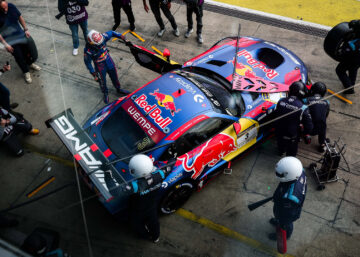
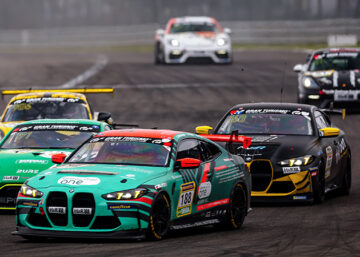
Last weekend, the Deutscher Sportfahrer Kreis e.V., an association combining motor sport people from all fields, invited a number of organisers of events at the Nürburgring Nordschleife as well as drivers and team managers to a round table which took place at the Nürburgring. This biggest association of active drivers and motor sport fans in Europe had received information that the partly reckless driving behaviour of single drivers at events at the Nordschleife had resulted in safety problems. The VLN endurance racing championship was represented by Dietmar Busch, Dr. Helmut Hermann, Hans-Jürgen Hilgeland and Karl Mauer and together with the other attendees, they all tried to get these problems under control.
“The Nordschleife is one of the most important elements in the VLN endurance racing championship Nürburgring”, said Mauer. “The VLN hence welcomes the initiative taken by the DSK and will actively contribute to improve safety at the Nordschleife – to the benefit of our officials and marshals as well of our participants.”
The summary taken by all persons present was that the aggressive and reckless driving at events on the Nordschleife had increased, that flag signals were not respected in many instances and that hence in particular the safety teams are frequently put into danger when they are working on the track. A study of the VLN, however, demonstrated that the number of accidents in races has decreased since 2008.
After an about two hours lasting discussion in which all the persons involved expressed their views openly and objectively, their findings resulted in four main issues which shall increase safety at the Nordschleife in near future:
1) Immediate protection: The protection of accident sites immediately after the incident must be improved. In addition to the yellow flags, strict speed limits shall be applied and checked to achieve this better.
2) Protection of recovery and rescue work: The quick deployment of intervention cars after an accident shall be applied to slow down participants and direct them through the accident site. The track width at the accident site shall be reduced using traffic cones so that the participants are forced to reduce speed considerably.
3) Infringements shall be strictly penalised. The Clerks of the Course and the Stewards are recommended to inflict much higher penalties on drivers failing to respect flag signals. The taking of evidence must hereby however be improved for any such reports and be supported by technical means.
4) Control of the drivers. The control of the drivers must be improved. For this purpose, the use of video systems around the track and in the cars shall be increased. About 70-80 percent of all cars are currently already equipped with on board cameras and data acquisition systems. These systems shall be available for Race Control and the Stewards to provide evidence. A simple combined device consisting of camera, GPS and data acquisition at a price of approximately 200 Euro was presented which seems to meet these requirements. In the longer term, track control shall also be improved as, in contrast to modern Grand Prix Circuits, there is no closed video system covering the Nordschleife and capable of following the races all around the track.