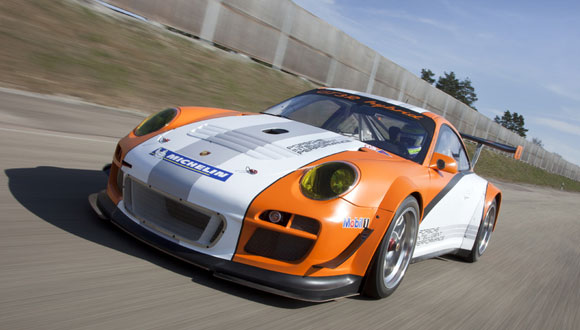
The development of the Porsche 911 GT3 R Hybrid 2.0 is running at full revs. This coming Saturday, the further-developed version of the innovative Hybrid race car will contest round two of the Nürburgring Endurance Racing Championship (VLN). Another test under race conditions is planned at the fourth VLN round on 28th May.
At the race debut of the upgraded version of the 911 GT3 R Hybrid on 30th April, Porsche works drivers Joerg Bergmeister (Langenfeld/ Germany), Marco Holzer (Lochau/ Germany) and Patrick Long (USA) will share the cockpit in the orange and white ‘race laboratory’. At the second race end of May, the crew of Holzer and Long will be completed by Richard Lietz (Austria) to drive the Hybrid-911.
Priority in the further development over winter was placed on the increase of efficiency. For this purpose, the weight of the vehicle was reduced from 1,350 to 1,300 kilograms in which the hybrid components have become lighter, too. The weight of these components was reduced by 20 percent through efficient optimisation. The general hybrid layout was adopted from the 2010 model.
The output of the two electric motors in the portal axle was increased from 60 to 75 kilowatts each. For seconds at a time, the drivers of the 911 GT3 R Hybrid 2.0 now have about 200 HP more at their disposal, which corresponds to about 23 kW (32 HP) of additional conventional power per lap at the Nordschleife. Depending on the programming, this electrical power is automatically added through the use of the throttle pedal. Furthermore, the hybrid drivers can manually call up this extra power, for instance when overtaking.
The electric flywheel accumulator with its rotor spinning up to 40,000 rpm and storing the energy mechanically as rotational energy is now housed with the other hybrid components in a carbon-fibre safety cell on the passenger’s side.
Whilst the portal axle drives the front wheels, the four-litre, now 465 HP strong six-cylinder boxer engine which drives the rear axle was reduced in power and optimised with respect to fuel consumption.
“We’ve made very good progress at the tests with the further-developed 911 GT3 R Hybrid. But testing under race conditions gives us additional information that can hardly be collected during a simulation,” says Hartmut Kristen, Head of Porsche Motorsport. “We will use the information gained from the VLN races to make our racing laboratory even more reliable and economical.”