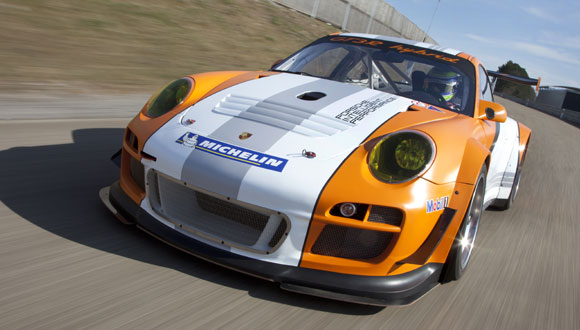
On 25th June, Porsche will compete in the 24 Hour Race Nürburgring with a further developed version of the Porsche 911 GT3 T Hybrid. The races of the VLN endurance racing championship Nürburgring shall provide an excellent preparation of the car to then race twice around the clock. The main focus in the development was given to the improvement of efficiency in optimizing the Hybrid components the weight of which could be reduced by 20 percent. Version 2 of the 911 GT3 R Hybrid shall achieve the same lap time as its predecessor but with less fuel consumption.
The general layout of the Hybrid was adopted from the 2010 model. A portal axis with two electric motors drives the front wheels and supplements the 4.0 litres, depending on the “balance of performance” classification approximately 470 hp strong six-cylinder boxer engine driving the rear. The output of both electric motors has increased from 60 to 75 kilowatts each. For seconds at a time, drivers of the 911 GT3 R Hybrid 2.0 now have an additional approximately 200 HP at their disposal. Depending on the programme, this power is automatically activated through the use of the throttle pedal. Furthermore, the drivers can manually call upon this electric extra power, for instance when overtaking.
The electric flywheel accumulator, with its rotor spinning at up to 40,000 rpm and storing energy mechanically as rotational energy, is now housed in a carbon fibre safety cell on the passenger’s side together with the other hybrid components.
At first glance already, the new GT3 R Hybrid is distinguishable from the 2010 model. Due to the optimisation of the hybrid system’s high voltage components in the cooling system, the large cooling louvers in front of the rear fenders were no longer necessary. This reduces air drag which also lowers fuel consumption. All in all, the weight of the vehicles could be reduced from 1,350 to 1,300 kilograms.
“We have collected a great deal of information from our races at the Nürburgring, at the ALMS race in Road Atlanta in the US as well as from the ILMC race at China’s Zhuhai circuit, which was a great help for the further development of our racing laboratory”, says Hartmut Kristen, head of Porsche motorsport. “The focus of our work was on improving efficiency. That means that we want to keep the lap times of 2010 but use less energy, hence less fuel. In this way, we support the future development of series production, sporting hybrid vehicles.”
The cockpit of the 911 GT3 R Hybrid has also been completely revised. Many of the displays and controls have thus been integrated into the steering wheel. Drivers can operate the rest of the functions via backlit buttons now situated on the centre console. Priority hereby was placed on the ergonomics and the clear layout for pilots – particularly in darkness.
The new 911 GT3 R Hybrid is a perfect example of the philosophy of “Porsche Intelligent Performance” – a principle which can be found in every Porsche: More power on less fuel, more efficiency and lower CO2 emissions – on the race track as well as on the road.