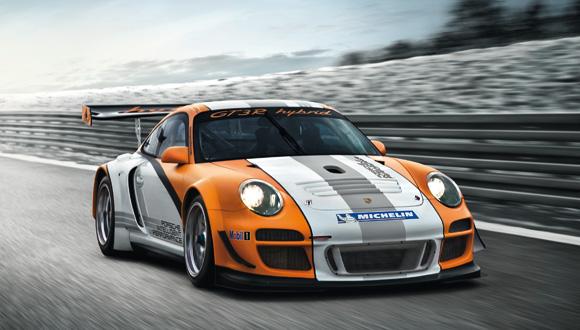
Precisely 110 years since Ferdinand Porsche developed the first vehicle with hybrid drive, the Lohner Porsche Semper Vivus, Porsche picks up this visionary drive concept for a production car-based GT racing programme. On 4th of April, a Porsche 911 GT3 R with an innovative hybrid drive will make its world debut at the Geneva Motor Show. Porsche will thus open a new chapter in the extremely successful history of the Porsche 911 as racing car with more than 20.000 victories in 45 years.
After its debut in Geneva, the 911 GT3 R Hybrid will complete its first tests in long-distances races at the Nürburgring. The highlight of this test programme will be the start at the 24 Hours Race at the Nürburgring Nordschleife on 15th/16th May. The Head of the Porsche Motor Sport Department, Hartmut Kristen, confirms to the specialised press: “It is compulsory to compete in two rounds of the endurance racing championship to be admitted for the 24h Race.” The focus for the 911 GT3 Hybrid, though, is not to win the races. It shall rather serve as a spearhead for the technology and as a so-called racing laboratory and thus provide valuable information for the subsequent use of hybrid technology in road vehicles.
The innovative hybrid technology has been developed especially for racing cars and differs clearly from conventional hybrid systems in its configuration and in the choice of components. An electrical front axle drive with two electric motors each developing 60 kW thus complete the 480 HP strong, four-litres flat-six ‘boxer’ engine at the rear of the 911 GT3 R Hybrid. Instead of the usual batteries fitted in conventional hybrid-powered road cars, an electric flywheel power generator, mounted inside the cockpit beside the driver, delivers energy to the electric motors on the front axle.
The flywheel generator itself is an electric motor, too, with rotors capable of spinning at speeds of up to 40.000 rpm and stores energy mechanically in form of rotation energy. This energy is stored under braking when the two electric motors at the front axle reverse their function and act themselves as generators. The driver is able to call upon this extra energy stored in the flywheel generator at his discretion, such as when accelerating out of corners or during overtaking manoeuvres. The flywheel generator is slowed down electromagnetically in the generator mode and up to 120 kW can thus be supplied to the two electric motors at the front axle. This additional power is available for the driver after each charge process for a duration of approximately six to eight seconds.
Energy which was formerly converted to heat and thus wasted upon every application of the brakes is now most efficiently converted into additional drive power. The hybrid drive, though, will not only be used for extra power but also to reduce fuel consumption. This increases the efficiency and such also the performance of the 911 GT3 R Hybrid, for example by reducing the weight of the fuel in the car or even by reducing the number of pit stops.